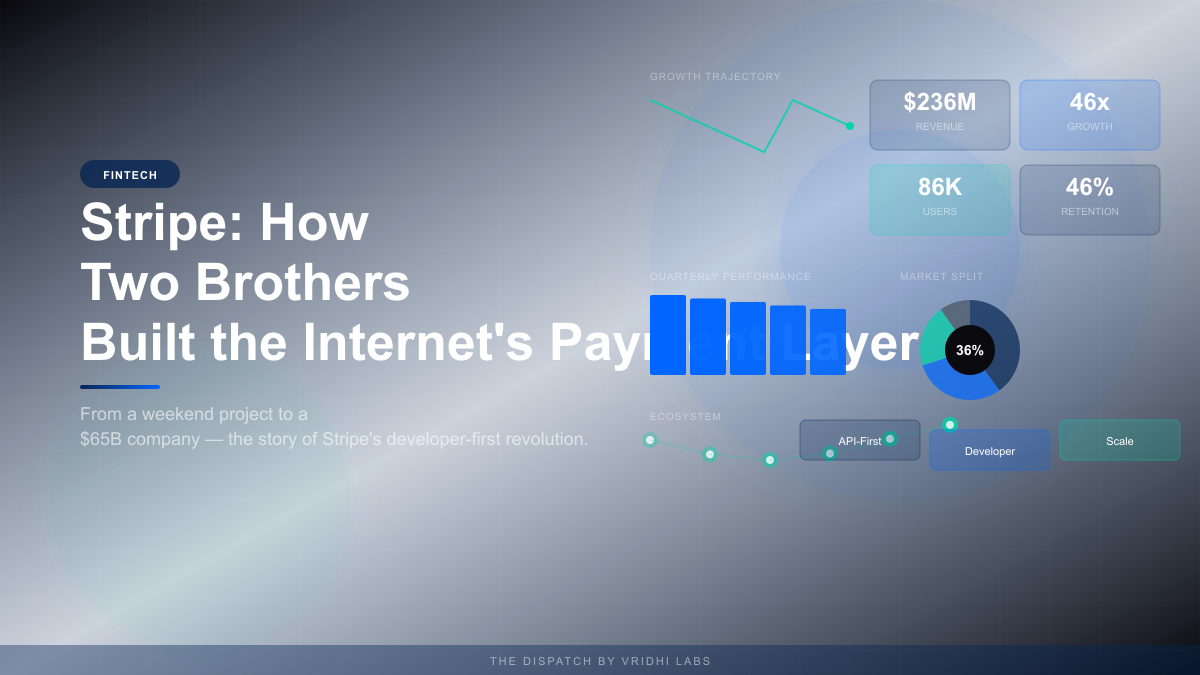
Stripe: How Two Brothers Built the Internet's Payment Layer
From a weekend project to a $65B company — the story of Stripe's developer-first revolution.
In today’s deep dive, we break down how Patrick and John Collison turned a weekend hackathon project into the infrastructure that powers millions of businesses worldwide.
But before we dive in, if you’re someone who loves understanding how companies actually grow, hit subscribe. We break down GTM strategies every week — no fluff, just mechanics.
The Problem Nobody Knew They Had
In 2009, accepting payments online was a nightmare.
You needed a merchant account from a bank. Weeks of paperwork. Integration that took months. Security audits that cost thousands. The incumbents — Authorize.net, Braintree, and direct bank integrations — treated payments as a banking product, not a software product.
Then two Irish brothers, Patrick and John Collison, decided to build what PayPal did for consumers — for developers. They wrote 7 lines of code that could accept a credit card. That was it. Seven lines.
$65B
Stripe’s valuation as of 2025 · Powers 10M+ businesses · 46 countries
The Old Way: Banking-Led Payments
Before Stripe, online payments meant dealing with banks. Authorize.net required paper applications, physical verification, and 2-4 weeks of onboarding. Integration needed server-side libraries that were poorly documented. Payment success rates hovered around 70%. Refunds required manual intervention.
The Incumbent Playbook:
- ❌ Paper applications and physical verification
- ❌ 2-4 week onboarding
- ❌ Complex, poorly documented APIs
- ❌ 70% payment success rates
- ❌ Manual refund processes
The New Way: Developer-First Payment Infrastructure
Stripe rebuilt payments from first principles — as a developer product. One line of code to integrate. 5-minute onboarding. 99.99% uptime. Real-time reconciliation. An API-first approach that let startups focus on their product while Stripe handled the money movement.
The Stripe Playbook:
- ✅ 7 lines of code to start accepting payments
- ✅ 5-minute onboarding (no paperwork)
- ✅ 99.99% uptime with intelligent routing
- ✅ Real-time reconciliation and reporting
- ✅ API-first architecture
How They Actually Grew
Phase 1: The YC Hack (2009-2011)
Patrick Collison applied to Y Combinator with a 5-page application that basically said “payments are broken, we fixed it.” Paul Graham was skeptical — he’d seen dozens of payment startups fail. But Patrick showed him the code: 7 lines that worked.
YC gave them $20K. Within 3 months, they had 100 developers using Stripe. By the end of YC, they had 500.
Phase 2: The Developer Evangelism (2011-2014)
Stripe didn’t hire salespeople. They hired developer advocates who went to meetups, wrote blog posts, and built integrations with every framework. Rails, Django, Node.js, PHP — if developers used it, Stripe had an SDK.
Their secret weapon: the Stripe Dashboard. Developers could see real-time data on payments, customers, and revenue. It was like Google Analytics for money.
Phase 3: The Platform Play (2014-2018)
Stripe realized payments was just the beginning. They added:
- Stripe Connect (marketplace payments)
- Stripe Atlas (company incorporation)
- Stripe Billing (subscriptions)
- Stripe Radar (fraud detection)
- Stripe Terminal (in-person payments)
Each new product made Stripe stickier. Once you used Stripe for payments, why would you switch to someone else for billing?
Phase 4: The Global Expansion (2018-Present)
Stripe expanded to 46 countries, localized for each market, and built partnerships with local banks. They didn’t just translate the interface — they rebuilt the payment rails for each country.
Key Metrics
| Metric | Value |
|---|---|
| Valuation | $65B (2025) |
| Businesses Powered | 10M+ |
| Countries | 46 |
| Payment Volume | $1T+ annually |
| Employees | 8,000+ |
| Revenue | $20B+ (est.) |
The Numbers That Matter
Revenue per employee: $2.5M — among the highest in tech
Net revenue retention: 150%+ — customers spend more each year
Payment success rate: 99.99% — best in class
Time to first payment: 7 minutes — from sign-up to first charge
What Breaks
1. Regulatory Risk Payments are heavily regulated. Each new country requires licenses, compliance, and local partnerships. One regulatory change could slow expansion.
2. Competition Adyen, Square, and PayPal are all competing for the same market. Plus, new players like Checkout.com are growing fast.
3. Concentration Risk A few large customers (Shopify, Lyft) account for a significant portion of revenue. Losing one could hurt.
Lessons for Founders
1. Developer Experience is a Moat Stripe didn’t win by being cheaper. They won by being easier. When your product is a joy to use, developers become your sales team.
2. Build the Platform, Not Just the Product Payments was the entry point. Billing, fraud, incorporation — each new product made Stripe stickier and harder to leave.
3. Localize Properly Stripe didn’t just translate their UI for each country. They rebuilt the payment rails. That’s why they’re in 46 countries while competitors are in 10.
4. Pricing as a Growth Lever Stripe’s pricing (2.9% + 30¢) was simple and transparent. No hidden fees, no minimums. That simplicity built trust with developers.
The Bottom Line
Stripe didn’t invent online payments. They made them developer-friendly. By treating payments as a software problem, not a banking problem, they created a $65B company that powers the internet’s economy.
The lesson? Sometimes the biggest opportunity isn’t building something new — it’s making something existing dramatically easier to use.
Want to understand how other companies built their GTM engines? Check out our deep dives on Razorpay, PhonePe, and Zerodha.
Last updated: June 2026
Want this playbook installed in your stack?
Book a free audit →Related Articles
Did you enjoy this article?
Your feedback helps us create better content.
✓ Thanks for your feedback!